
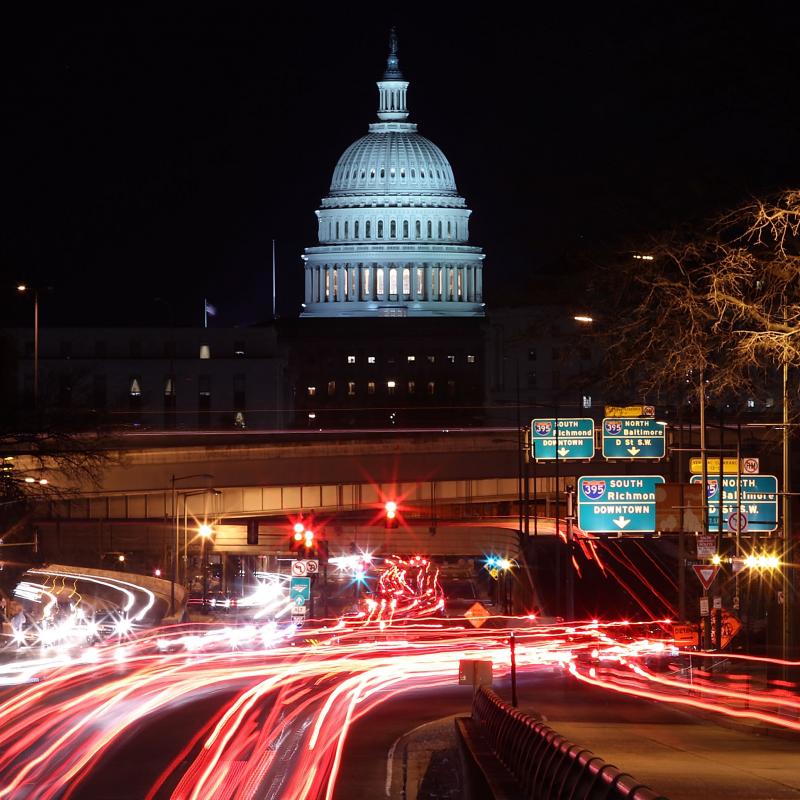
Nighttime view of the US Capitol building with a time-lapse of cars speeding by below

Government & Politics

Filter by

Select Topics

Select Air Date

to

Select Segment Types

Segment Types

4,491 Segments

Sort:

Newest

44:35

Former United Nation's Chief Weapons Inspector Scott Ritter on Weapons Inspection in Iraq.

Former United Nation's Chief weapons inspector Scott Ritter spent seven-years hunting down Saddam Hussein's weapons of mass destruction. He has written about his experience in "Endgame: Solving the Iraq Problem Once and for All." (Simon and Schuster) He resigned his U.N. post in August 1998 claiming the U.N Security Council and the U.S. Government had fatally undermined his team's ability to do its job. Ritter served as an Intelligence officer in the U.S. Marines for eight-years.

Interview
33:25

Former Hostage Terry Anderson Discusses Suing Iran.

Former hostage Terry Anderson talks about his 100-million dollar lawsuit against the government of Iran. He alleges Iran supported the Islamic extremists who kidnapped him and held him hostage for seven-years. The former Associated Press Middle East correspondent now teaches journalism at Ohio University. The lawsuit was filed last week in U.S. District Court in Washington. The Iranian government denies any role in his captivity. We'll first listen back to an excerpt from Anderson's 1993 (12/28/93) interview with Terry. And then we have their current interview.

Interview
27:42

What's at Stake in Kosovo?

The New York Times' Roger Cohen puts in a call from Berlin. Cohen reported from Bosnia during the war there. He's the author of the book, "Hearts Grown Brutal: Sagas of Sarajevo."

Interview
22:03

The Spokeswoman for Belgrade station Radio B92, Julia Glyn-Pickett.

To discuss the situation in Kosovo and the NATO bombings, a talk with Julia Glyn-Pickett the spokeswoman for Belgrade station Radio B92, the leading independent radio station in Serbia, one of three provinces of the Republic of Yugoslavia. Earlier this week the Yugoslavian government banned the station from broadcasting and journalists were forbidden to talk with foreign media about the situation. The government also expelled journalists from Britain, France, the U.S., and Germany. The journalist will speak to us from London.

Interview
21:45

The "New" South Africa.

Journalist David Goodman. He's written a new book about post-apartheid South Africa, "Fault Lines: Journeys into the New South Africa" (University of California Press). He tells the story of four South Africans whose lives are divided by race and/or class. Goodman has written for The New Yorker, The Nation, Boston Globe, and the Village Voice. Archbishop Desmond Tutu says of his book, "A searingly honest b

Interview
04:25

Language and the European Union.

Linguist Geoff Nunberg reflects on Europanto, a form of language aimed at allowing Europeans to talk with each other without using English all the time.

Commentary
06:19

The Controversy Over Elia Kazan's Honorary Academy Award.

Film critic John Powers comments on the plan to award Elia Kazan an honorary Academy Award. Kazan is best known for his films "On The Waterfront," and "A Streetcar Named Desire." The award is controversial because Kazan turned over names of suspected communist members during the 1950s.

Commentary
13:47

What the U. S. Knew about Guatemalan Atrocities.

Analyst for the National Security Archives, Kate Doyle. She directed the Guatemalan Documentation Project, which lead to the declassification of documents from the CIA, the State and Defense Departments on Guatemala. These documents were handed over to the commission and filled the gap left by Guatemalan military which claimed its files had been lost.

Interview
21:18

Christian Tomuschat Discusses Human Rights Abuses in Guatemala.

Professor of international law Christian Tomuschat, headed the Historical Clarification Commission on Guatemala, a United Nations-supported truth commission on human rights abuses in Guatemala during that country's 36 year civil war. A peace treaty was signed in Guatemala in 1996. The report was issued last month. It finds that the U.S. agencies knew far more about atrocities committed by the Guatemalan Army and its death squads than the United States acknowledged.

13:57

Rape and Torture During the Guatemalan Civil War.

Political anthropologist Jennifer Schirmer. Beginning in 1986, she interviewed Guatemalan military officials of all different levels, getting them to talk about their participation in atrocities. Her new book based on that research is "The Guatemalan Military Project: A Violence called Democracy." (University of Pennsylvania Press)

Interview
33:58

"The Resurrection of Saddam Hussein."

Journalist Patrick Cockburn (CO-BURN). He's been a senior Middle East Correspondent for the Financial Times and the London Independent. He's the co-author of the new book, "Out of the Ashes: The Resurrection of Saddam Hussein" (HarperCollins). He'll discuss the bombing campaign against Iraq, Saddam's hold on power, the royal family and more.

Interview
20:04

"The Untold Story of American Submarine Espionage."

Journalists Sherry Sontag and Christopher Drew. They are the authors of the new book, "Blind Man's Bluff: The Untold Story of American Submarine Espionage" (PublicAffairs). The two spent six years researching secret submarine missions like how the Navy sent submarines wired with self destruct charges into Soviet waters to tap crucial underwater telephone cables. Sontag covered government and international affairs for the National Law Journal and has worked at the New York Times, and Drew is a special projects editor at the New York Times.

35:11

Tom Blanton and "The Kissinger Transcripts."

Tom Blanton is the Director of the National Security Archive, A research library at George Washington University in Washington D.C. His department, using the Freedom of Information Act, obtained the transcripts of former Secretary of State Henry Kissinger. The now declassified papers detail Kissinger's secret negotiations with key world leaders such as Leonid Brezhnev, Andrei Gromyko, Mao Zedong, and Deng Xiaoping. The transcripts have been edited and published in the new book "The Kissinger Transcripts" (The New Press)

Interview
22:05

Prosecuting Genocide.

Pierre-Richard Prosper served as a prosecutor for the International Criminal Tribunal in Rwanda. In 1994, more than a half-million Rwandans were killed in a massacre. Last year, he successfully prosecuted the former Mayor of Taba, Rwanda for genocide. He also convicted the former official on rape charges. This is the first time rape has been recognized as a instrument of genocide. Prosper is an American attorney who worked for the Justice Department and for the Los Angeles County D.A.'s office.

21:27

Photographer Fazal Sheikh.

Photographer Fazal Sheikh. (Fuz-ill) (Shake) In his new book "The Victor Weeps: Afghanistan" published by Scalo, Sheikh weaves portraits and stories together to document their experience. His 1996 book "A Sense of Common Ground,"(Scalo) presented a series of photographs taken of African refugees.

Interview
16:40

Suing the Gun Industry: Can Gun Manufacturers Be Held Responsible for Crime?

Last year New Orleans became the first city to file suit against the gun industry. Chicago followed. And now many other cities (including Philadelphia, Boston, Miami, San Francisco and L.A.) are considering similar actions. Journalist Fox Butterfield writes about crime and criminal justice for The New York Times. He'll discuss these suits as well as one filed in New York by a group of individuals who lost family members from gun violence. Butterfield was a member of the Times writing staff that won a Pulitzer Prize for its publication of The Pentagon Papers.

Interview

All Subtopics

Did you know you can create a shareable playlist?

Advertisement

There are more than 22,000 Fresh Air segments.

Let us help you find exactly what you want to hear.
Just play me something
Your Queue

Would you like to make a playlist based on your queue?

Generate & Share View/Edit Your Queue